Tribhuvan International Airport (TIA) in Kathmandu remained closed for four and a half hours on Saturday evening after an electrical short circuit occurred on the runway, forcing around a dozen international flights to divert to airports as far as India and Bangladesh.
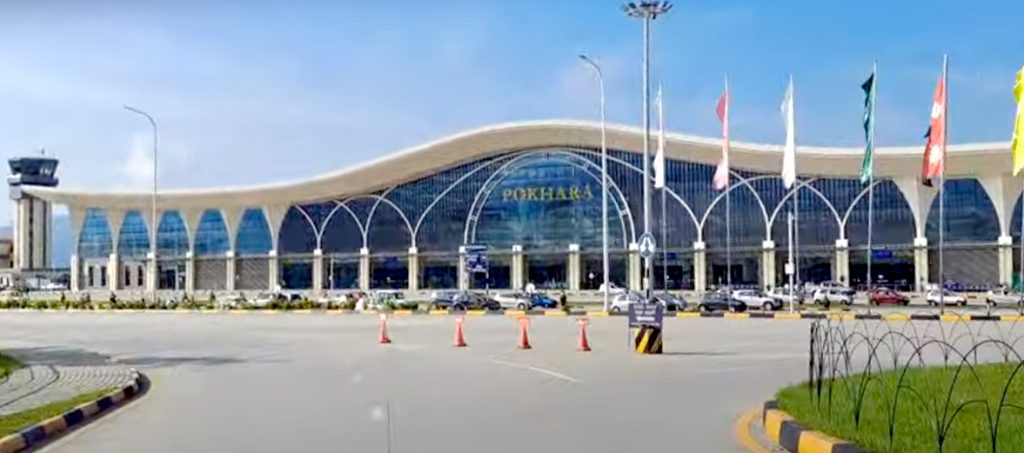
During the disruption, several international aircraft circled over Simara before being rerouted: Qatar Airways diverted to Dhaka, Korean Air to New Delhi, and Fly Dubai to Lucknow. However, none of the flights chose to land at the nearby Pokhara or Bhairahawa international airports, both built as alternative aviation hubs to TIA.
Despite having the necessary facilities for emergency landings, the two newer airports were not utilized as alternatives. Former Director General of the Civil Aviation Authority of Nepal (CAAN), Rajkumar Chhetri, said that both airports have the infrastructure required for international emergency landings.
Pokhara International Airport’s Managing Director Jananath Niraula also stated that ground handling services, technical teams, and hotel accommodations are in place to receive international flights. Earlier in Falgun 2081 (February 2025), an Air China aircraft unable to land in Kathmandu had successfully diverted to Bhairahawa.
CAAN spokesperson Rinji Sherpa clarified that Tribhuvan Airport does not hold the authority to divert international flights to Pokhara or Bhairahawa in emergencies.
“Each airline pre-determines its alternative airport based on operational convenience before taking off from the country of origin. The choice depends on the airline and passenger suitability — we cannot decide where to divert their flights,” Sherpa explained.
CAAN Information Officer Gyanendra Bhul also dismissed concerns that the two airports were inadequate simply because flights did not divert there.
“Both Pokhara and Bhairahawa airports have already handled wide-body and narrow-body aircraft at full capacity,” Bhul said. “This proves there are no technical issues. The absence of diversions does not mean these airports are non-functional.”
Sherpa added that handling diverted international flights requires full ground-handling facilities, passenger inspection, overnight accommodations, and technical support teams—amenities that may not be available at the same scale as Tribhuvan International Airport.
Former CAAN Director General Chhetri said the main reason aircraft did not divert to Pokhara or Bhairahawa is the lack of regular international flights. He emphasized the need for better promotion and branding of these airports.
To encourage airlines, the government has already announced up to 75% discounts on ground-handling charges and waived all landing and parking fees at Pokhara and Gautam Buddha International Airports until 2083 BS (2027 AD). Passengers flying from these airports are also exempted from airport service fees (Rs 3,000), tourism fees (Rs 1,000), and 13% VAT, according to the Ministry of Culture, Tourism and Civil Aviation.
Gautam Buddha International Airport: Fully Equipped but Underutilized
Gautam Buddha International Airport in Bhairahawa was built as Nepal’s second international gateway to serve as an alternative to Kathmandu. After eight years of construction—starting with the foundation laid in Magh 2071 (January 2015)—the airport began operations in Jestha 2079 (May 2022).
Intended to reduce flight pressure at TIA, the airport can currently handle up to 2 million passengers annually, with plans to expand capacity to 7 million after completion of its second terminal.
The total cost has reached approximately Rs 31 billion, with construction expenses alone at Rs 11 billion, according to CAAN. The airport can support both Visual Flight Rules (VFR) and Instrument Flight Rules (IFR) operations, qualifying it as a “National Pride Project.”
Although international flights initially began with Air Jazeera, other airlines such as Qatar Airways, AirAsia, Fly Dubai, and Nepal Airlines have intermittently operated there. Currently, only AirAsia maintains regular flights.
Pokhara International Airport: Operational but Limited to Domestic and Occasional Charter Flights
Pokhara International Airport—Nepal’s third international airport—was inaugurated on January 1, 2023 (Poush 17, 2079), nearly 47 years after the first land acquisition began in 2032 BS. Located in Nepal’s tourism capital, it can handle 1 million passengers annually, serving up to 610 passengers per hour.
Built with a Rs 22 billion concessional loan from China’s Exim Bank, the airport operates under the 4D ICAO standard, accommodating aircraft up to Boeing 757 and Airbus A320 types. It was constructed over 3,899 ropani of land, with 75% loan financing and 25% Chinese grant support.
Currently, Himalaya Airlines operates weekly flights between Pokhara and Lhasa, while Bhutan Airlines is preparing for chartered flights on Mangsir 2 and 6 (November 17 and 21, 2025). Sichuan Airlines has also expressed interest in resuming its Pokhara route.
Despite being equipped for IFR operations and night flights, Pokhara mostly handles domestic flights, with very few international operations.
Tribhuvan International Airport: Operating at Full Capacity
As Nepal’s only fully functional international hub, Tribhuvan International Airport handles an average of 350 daily flights, including both domestic and international. Around 30 international airlines and 21 domestic and helicopter operators use the airport, serving 23,000 passengers daily—roughly 7.5 million annually.
TIA accommodates aircraft up to Airbus A330 size and remains the country’s busiest aviation hub.
Related posts:
 The balloon festival in Pokhara is drawing more local tourists than foreign ones
 Visit Pokhara 2025: Pokhara has set a high target to welcome two million visitors
 The central bank rejects the NEA’s request to freeze the accounts of defaulters
 NEA will reduce industrial electricity supplies throughout the winter
 After an 88-day closure, Upper Tamakoshi is now generating electricity again
 The government completes an investment plan worth USD 46.5 billion to generate 28,500 MW of electricity by 2035
 To advance the hydropower industry, Nepal and France have launched the HydroNepal Project
 Nepal’s agricultural imports reach Rs 203 billion, surpassing the figure from the previous year
 Widespread Power Outage Raises Load-Shedding Concerns, NEA Assures “No Such Situation”
 Record High Revenue from Expensive Property Transactions in Asar Alone
Nepal Exports Electricity Worth Rs 17.45 Billion in FY 2081/82
Record High Revenue from Expensive Property Transactions in Asar Alone
Nepal Exports Electricity Worth Rs 17.45 Billion in FY 2081/82
 Land Transactions Decline Amid Plot Classification Halt in 500 Municipalities