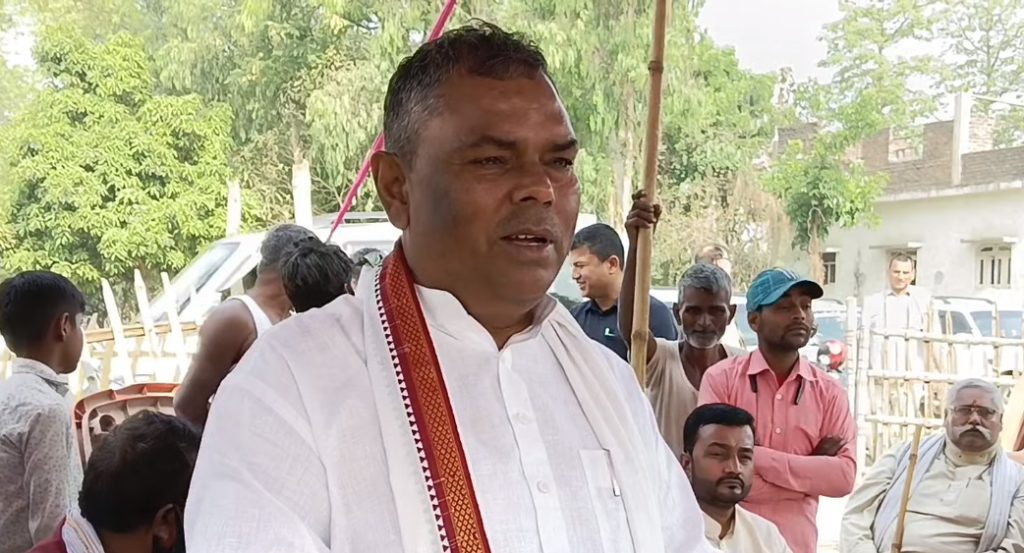
The Janata Samajwadi Party (JSP) Nepal, led by Upendra Yadav, has announced a nationwide protest against the proposed Land Bill in the House of Representatives. The party has circulated a directive instructing all its committees to stage protests across the country from September 25 to 31.
JSP Nepal believes the bill is not in the interest of the nation or its citizens. Party General Secretary Lalbabu Raut, in a letter circulated to party offices on Saturday, called for strong protests and instructed members to be prepared for counter-actions if obstructed.
“The Land Bill serves the interests of land mafias and brokers. It will lead to the destruction of forests. The government is attempting to turn the Terai-Madhes region into a desert through this legislation,” read the statement issued by Secretary Raut. “Despite JSP Nepal’s opposition from the beginning, the bill was passed by the Parliamentary Agriculture, Cooperative and Natural Resources Committee on September 19 (Bhadra 5) and submitted to the House of Representatives.”
Following the government’s decision to push the controversial bill against national interest, JSP Nepal’s central secretariat decided to intensify protests.
JSP Nepal’s 10-Point Objections to the Land Bill
- Environmental Impact & Demographic Shift: If passed, the bill could destroy the Chure forests, harm biodiversity, and increase population pressure in the Terai-Madhes, marginalizing indigenous Madhesi, Tharu, Muslim, and other communities.
- Illegal Land Allocation: The bill could allocate public lands, riversides, forests, national parks, grazing areas, and markets to illegal occupants and encroachers.
- Rewarding Forest Destruction: Criminalizing forest destruction is meaningless if violators are rewarded with land, setting a wrong precedent and encouraging further encroachment.
- Undermining Forest Offices: Legalizing illegal actions undermines the purpose of forest offices and government expenditure on conservation.
- Disadvantage to Genuine Landless: Law-abiding, truly landless citizens would struggle to receive land while illegal occupants benefit.
- Benefit to Land Mafias & Brokers: The bill favors land mafias, brokers, and real estate businesses.
- Provincial Jurisdiction Ignored: As per Schedule 6 of the Constitution, land management and record-keeping are under provincial authority, which the bill disregards.
- Existing Laws Sufficient: Current land laws (Land Act 2021, 8th Amendment, 2076 BS) can address the problems of genuine landless and unorganized settlers.
- Political Gain over Citizens’ Rights: The government aims to distribute forest lands to fake settlers for political advantage, worsening the plight of Dalits, the poor, and genuine landless communities.
- Repeating Failed Ordinance: The bill mirrors the previously failed land ordinance without addressing key issues or specifying how land will be distributed to genuine landless settlers.
Context & Political Implications
The Land Bill was first tabled in the House on May 6 (Baisakh 23). Opposition lawmakers from JSP Nepal submitted a 10-point amendment proposal, arguing the bill centralizes land rights and undermines local governance. Party MP Prakash Adhikari stated that certain provisions of the bill violate the Constitution and conflict with existing land classification policies.
Earlier, a similar ordinance failed in the National Assembly due to opposition from JSP Nepal. Party officials assert that the current bill largely replicates the failed ordinance, endangering Madhesi forests and riverine lands by handing them over to brokers and encroachers.
JSP Nepal’s General Secretary Ramkumar Sharma emphasized:
“The bill aims to marginalize the Madhesi population in their own land. We will not allow its passage under any circumstances.”
This ruling and protest reflect ongoing debates over land rights, environmental protection, and the balance between central and local governance in Nepal.
Related posts:
 Police begin a new investigation into the rape and murder case of Nirmala Panta
 The accountant’s records at Gorkha Media are in conflict with Lamichhane’s statement
 RSP at a crossroads as demands for the reinstatement of Mukul Dhakal increase
 Opp parties start talking about the agenda for constitutional amendments
Rabi Lamichhane is released by the court on Rs 6 million bail in the Swarnalaxmi Cooperative fraud case
Opp parties start talking about the agenda for constitutional amendments
Rabi Lamichhane is released by the court on Rs 6 million bail in the Swarnalaxmi Cooperative fraud case
 The Oli-Ordinance contains 29 provisions, the age of retirement was raised from 58 to 60
 Debate surrounds Bhim Rawal’s expulsion: Is the UML adopting dictatorial leadership?
 PM Oli Set to Visit India After UN Conference in Spain
 PM KP Oli to Visit India Starting September 16
 Leadership Clash Escalates Within RPP
 Rabi Lamichhane Transferred to Nakkhu Prison from Rupandehi
 Nepal Parliament Dissolution and Interim Government Formation Done with Political Consensus