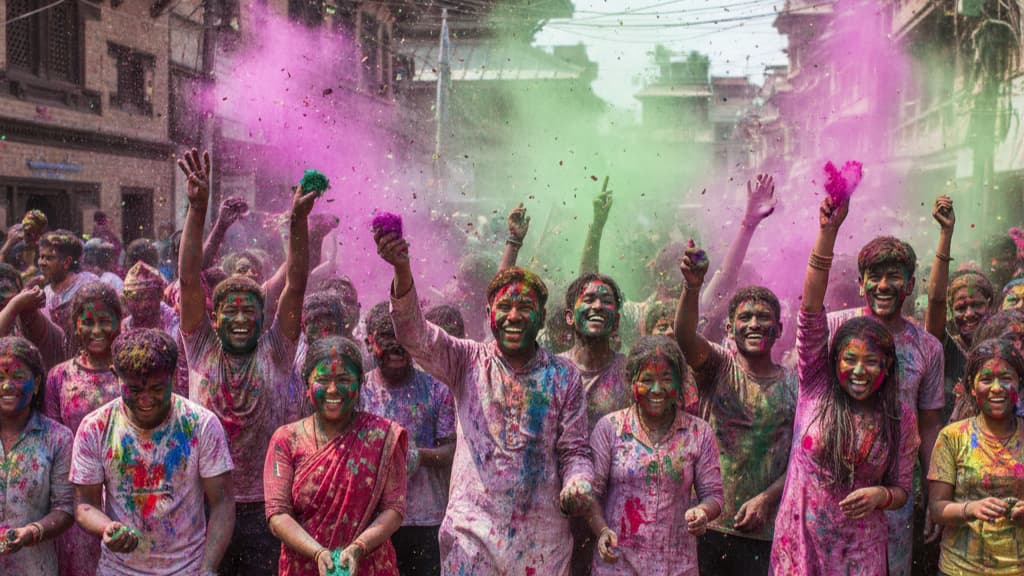
The Holi festival is being celebrated across Nepal today with great joy, colors, and festive gatherings. People celebrate the festival by playing with colors and water balloons, sharing happiness, and strengthening social harmony.
Holi, also known as Fagu Purnima, is celebrated every year on the full moon day of the bright fortnight of the Nepali month of Falgun. The festival marks the arrival of spring and carries the message of friendship, unity, and goodwill. The tradition of celebrating Fagu dates back to ancient times.
The Government of Nepal has been giving a public holiday on this occasion for many years. While the festival is celebrated today in the hilly and Himalayan regions, people in the Terai districts celebrate Holi the next day. This year, the festival will be celebrated in the Terai region on Tuesday, March 3, 2026 (Falgun 19, 2082 BS), and the government has declared a public holiday there as well.
Basantapur Ceremony and Chhir Tradition
On the occasion of Holi, people gather at Basantapur Durbar Square in Kathmandu, where the ceremonial pole known as Chhir is taken down with traditional music and carried to Tundikhel, where it is burned according to ritual practice.
It is believed that the flags attached to the Chhir have medicinal value, so people collect them during the ceremony. Devotees also apply ash from the burned Chhir as a tika, believing it protects them from misfortune.
The Holi celebration formally begins on Falgun Shukla Ashtami, when the Chhir is erected in front of the Gaddi Baithak in Basantapur after special worship. According to tradition, a ritual is also performed at night in Tundikhel, where food offerings are made as part of an ancient Newar custom.
Mythological Story Behind Holi
The origin of Holi is linked to the mythological story from the Treta Yuga. Demon king Hiranyakashipu tried to kill his son Prahlad, a devotee of Lord Vishnu, by asking his sister Holika, who had a boon that fire could not harm her, to enter a burning fire with Prahlad. However, Holika was burned to ashes while Prahlad remained unharmed. Since then, Holi has been celebrated as the victory of devotion and truth over evil.
Another legend from the Dwapar Yuga mentions that the demoness Putana, sent by King Kansa to kill Lord Krishna, failed in her attempt and was killed. The people of Vraj burned her body and celebrated, which is also believed to be the origin of the Holi festival.
Holi continues to be one of the most joyful festivals in Nepal, symbolizing the triumph of good over evil and the strengthening of social bonds.
Related posts:
 Night flights start at Rajbiraj Airport
 According to MoLESS reports Over 14,000 Nepali migrants have died overseas in the past 15 years
 Investigating Dailekh’s Oil Reserves
 The government passes an ordinance to reimburse depositors from troublesome cooperatives
 RSP at a crossroads as demands for the reinstatement of Mukul Dhakal increase
 The Nepali drug authority orders pharmacies to stop offering unlawful cosmetics and food supplements
 The Oli-Ordinance contains 29 provisions, the age of retirement was raised from 58 to 60
 Debate surrounds Bhim Rawal’s expulsion: Is the UML adopting dictatorial leadership?
 Modernization of postal services is planned: Prithvi Subba Gurung, Minister
 International online scamming is busted by CIB
 ANFA Politics Sideline Football in Nepal: A-Division League Still on Hold
 Tourist Rush in Annapurna and Mustang Surprises Local Businesses