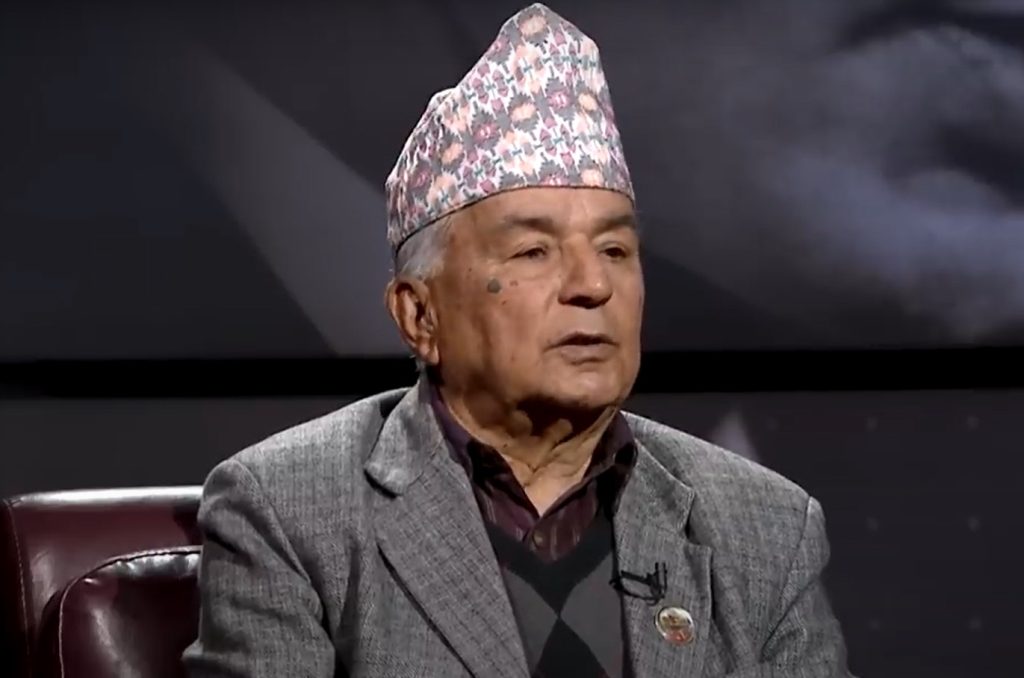
Major political parties in Nepal have expressed opposition to the dissolution of parliament and the formation of an interim government led by Suśhila Karki, calling the moves unconstitutional. However, following the “Jan-G” (Gen-G) movement and subsequent political unrest, President Ram Chandra Paudel appointed Karki as Nepal’s interim Prime Minister on the recommendation of caretaker Prime Minister KP Sharma Oli, with a mandate to hold the next House of Representatives election within six months.
Before taking this decision, President Poudel consulted with leaders from the Congress, UML, and Maoist parties, reaching a consensus. Political parties, however, held differing views on whether they would participate in the upcoming elections.
Constitutionalist Chandrakant Gyawali, who visited Sheetal Niwas on 11 September 2025 (26 Bhadra), said, “The President consulted multiple times with caretaker PM Oli from Sheetal Niwas. Oli assured that if the constitutional provisions were respected, he would recommend and consent to the interim government.”
President Poudel also held an in-depth discussion lasting nearly six hours with Gyawali, Vipin Adhikari, Bhimarjun Acharya, Surya Dhungel, Baburam Kunwar, and Lalit Basnet. These deliberations paved the way for a constitutional resolution to the crisis.
The discussions concluded that the Jan-G movement’s key demands—good governance, directly elected prime minister, impartial appointments to constitutional bodies, and parliament dissolution—aligned with the spirit of Article 66 of the Constitution. This article empowers the President to act on the Prime Minister’s recommendation, which Oli invoked when recommending Karki’s appointment.
A press release from the President’s Office stated:
“To promote national unity, the President has appointed Suśhila Karki of Morang as the interim Prime Minister of Nepal, based on the recommendation and consent of the Prime Minister, in accordance with constitutional provisions. The next House of Representatives election will be held within six months.”
According to Gyawali, consultations were not limited to PM Oli alone; the President also met top leaders of other political parties at Sheetal Niwas, with some invited to the President’s office directly.
The day after Karki’s appointment and parliament dissolution, President Poudel issued a statement urging all parties to cooperate in ensuring peaceful elections on February 3, 2026 (21 Falgun 2082 BS), emphasizing that the opportunity must be used judiciously to gain public trust. He highlighted that the resolution came after immense effort in extremely challenging, tense, and fearful conditions, reaffirming the constitution, parliamentary system, and federal democratic republic.
Sources close to the President confirmed that in the unusual scenario of constitutional uncertainty, Poudel sought consensus with top leaders of Congress, UML, and the Maoist party to navigate the political course.
Gyawali noted:
“President Poudel dedicated his life to democracy and the Constitution. He had no personal interest; the goal was to save the system collectively. The interim government was formed based on political necessity, movement demands, and consensus among all stakeholders, making it constitutionally and politically legitimate.”
Under Article 77 (3) of the Constitution, with Oli’s government having completed its caretaker term, forming a new government under Articles 76 (2), 76 (3), and 76 (5) was not possible. The President’s main concern was how to form an interim government under difficult political circumstances and how and when to dissolve parliament.
During the Sheetal Niwas consultations, constitutional experts presented four potential models for forming a new government:
- Form the government through regular constitutional procedures with Jan-G consent, allowing nominated individuals to serve as ministers for six months.
- Appoint a Jan-G-backed MP as Prime Minister, with their representatives serving as ministers for six months.
- President announces PM appointment from outside parliament, which is then ratified in parliament under Article 99.
- Recommend caretaker PM Oli to form an interim government, based on the movement’s exceptional circumstances, sacrifices, and public sentiment—this model was agreed upon with Jan-G representatives.
On 11 September 2025 (26 Bhadra), constitutionalists prepared a preliminary draft at Sheetal Niwas to appoint Karki as interim PM and dissolve parliament upon her recommendation. However, Jan-G representatives insisted parliament be dissolved before the PM appointment, causing a one-day delay.
Related posts:
 Police begin a new investigation into the rape and murder case of Nirmala Panta
 The accountant’s records at Gorkha Media are in conflict with Lamichhane’s statement
 RSP at a crossroads as demands for the reinstatement of Mukul Dhakal increase
 Opp parties start talking about the agenda for constitutional amendments
Rabi Lamichhane is released by the court on Rs 6 million bail in the Swarnalaxmi Cooperative fraud case
Opp parties start talking about the agenda for constitutional amendments
Rabi Lamichhane is released by the court on Rs 6 million bail in the Swarnalaxmi Cooperative fraud case
 The Oli-Ordinance contains 29 provisions, the age of retirement was raised from 58 to 60
 Debate surrounds Bhim Rawal’s expulsion: Is the UML adopting dictatorial leadership?
 PM Oli Set to Visit India After UN Conference in Spain
 PM KP Oli to Visit India Starting September 16
 Leadership Clash Escalates Within RPP
 Rabi Lamichhane Transferred to Nakkhu Prison from Rupandehi
 Nepal’s Private Sector Stunned as Youth Killed in Anti-Corruption Protest Crackdown