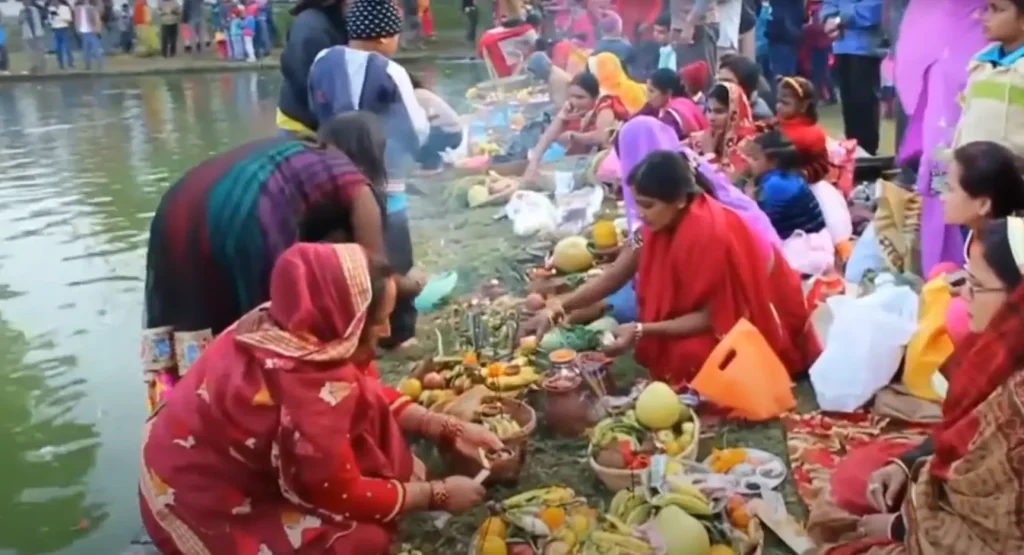
Chhath is not merely a religious festival; it is a profound blend of faith, purity, labor, equality, and gratitude toward nature. Unlike other rituals performed within closed walls, Chhath is observed under the open sky and beside water bodies, symbolizing both community and devotion. The four essential elements of this festival—water, earth, sun, and human labor—remind us that existence lies not within the confines of the household but in harmony with nature.
During Chhath, devotees gather at riverbanks or ponds, standing knee-deep in water beneath the sky to offer arghya (water offering) to the setting and rising sun. The ritual transcends religious boundaries, serving as a meeting point between humanity and nature.
Ancient Roots of Sun Worship
Sun worship is among the most ancient traditions of human civilization. The Rigveda describes the Sun as the giver of life, destroyer of diseases, and source of energy. Chhath is believed to be a continuation of that same Vedic tradition.
According to mythological accounts, Kunti observed the Chhath fast to be blessed with sons, while Draupadi performed the same ritual to overcome hardships. It is said that Lord Surya (the Sun God) granted them divine blessings in return.
The practice has ancient roots in the Mithila, Bhojpur, Bihar, and Eastern Terai regions, where farmers and rural communities have celebrated Chhath for centuries to express gratitude for harvests and sunlight.
Mythological Significance
According to ancient beliefs, Chhathi Mata is considered the female form of the Sun God. Legends say that when Sage Narada, proud of his celibacy, was enchanted by the beauty of a woman bathing in a pond before sunset—an illusion created by Lord Vishnu—the Sun God laughed at him. Angered, Narada cursed the Sun to live as a woman.
Later, at Vishnu’s mediation, the curse was limited to one day each year—Kartik Shukla Shashthi, the day when the Sun is worshipped as Chhathi Mata.
In some scriptures, Chhathi Mata is also identified as Usha, the wife of the Sun—personified as the first light of dawn that brings hope and new beginnings. In folk traditions, she is sometimes seen as the Sun’s sister.
Despite different interpretations, all forms of worship ultimately honor the Sun as the sustainer of life.
Rituals and Four-Day Observance
Although it appears as a single day on calendars, Chhath is a four-day festival, celebrated from Kartik Shukla Chaturthi to Saptami.
Each day carries spiritual and symbolic significance:
- Day One (Nahay-Khay):
Devotees bathe early, cleanse their homes, and prepare pure vegetarian food. This marks the beginning of purity and restraint. - Day Two (Kharna):
The fast intensifies, with the offering of kheer (sweet rice pudding) prepared with utmost purity. - Day Three (Sandhya Arghya):
Devotees gather at the riverbank or pond to offer prayers to the setting sun amidst songs and lamps. - Day Four (Usha Arghya):
The final day begins before dawn, with offerings to the rising sun, marking the completion of the fast.
The reflection of the sun on the water, the glowing lamps, and the serene faces of devotees create a deeply spiritual atmosphere filled with peace, hope, and joy.
Symbolism Beyond Religion
Chhath stands apart from other festivals. It is a vivid expression of social harmony, sustainable culture, and self-reliant living. All offerings are homemade, not market-bought, which strengthens local economies and respects labor.
The festival also holds scientific significance—exposure to sunlight provides Vitamin D, while standing barefoot in water enhances energy flow and grounding.
The discipline of fasting and purity reinforces mental and physical strength.
Family members actively participate—cleaning, preparing offerings, decorating the riverbanks, and singing devotional songs. Women lead the rituals, demonstrating leadership, faith, and unity. When the family stands together offering arghya, it symbolizes emotional and spiritual togetherness beyond ritual.
Global Presence and Message of Equality
Today, Chhath is no longer confined to Mithila or Madhes. Nepali and Indian diaspora communities in Australia, America, and Europe have begun creating artificial ponds to celebrate it abroad.
The festival delivers a universal message—of equality, cleanliness, and coexistence with nature. It brings the rich and the poor, the upper and lower castes, and people of all faiths together on the same riverbank, symbolizing social equality and ecological balance.
Chhath teaches us that:
- Nature is the temple.
- Labor is sacred.
- Equality is culture.
When rich and poor stand side by side at the same riverbank, when homes are outshined by decorated ponds, and when offerings come not from markets but from one’s own fields—Chhath becomes not merely a ritual but a celebration of humanity and collective consciousness.
Related posts:
 Nepal’s revenue from the export of IT services increased by 20.28 percent in the first four months of the current fiscal year
 Mayor Shah of KMC will take action against the Chief Executive Officer
 Since Chairman Lamichhane is still imprisoned, RSP is led by Make-Do
 The price of cardamom has risen to Rs 110,000 per mann, the highest in 12 years
 Beginning on January 23, GBIA will employ a satellite-based alternate landing system
 Ordinances are introduced by the government as a means of promoting private sector investment
 Fast-track construction advances 37%
 Due to the cold, schools in Khajura and Nepalgunj were closed for three days
 Bill on Social Media to tighten the net around offenders
 Increased cross-border cyber crime networks and police challenges
 Pokhara garbage piles due to a dispute about disposal
 The government’s budget cap for the next fiscal year is Rs 1.9 trillion