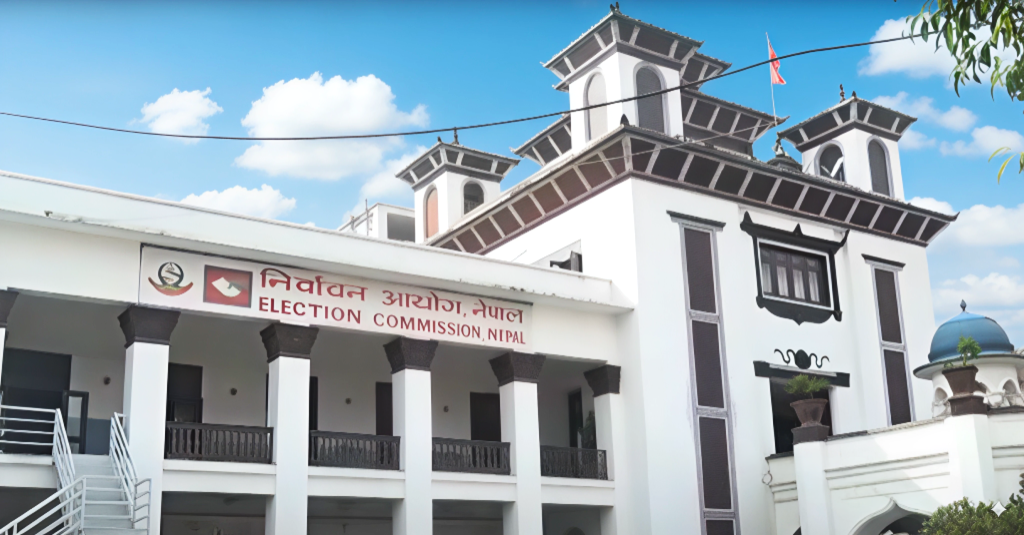
The Election Commission (EC) has proposed a new provision requiring political parties and elected representatives to publicly release annual progress reports based on the commitments outlined in their election manifestos. The proposal is included in the draft of the “Election Code of Conduct, 2082”, prepared for the upcoming House of Representatives elections scheduled for Falgun 21.
The draft code of conduct has been made public for discussion. According to the EC, political parties and elected candidates must publish their election manifesto every year for public information. The commission has circulated the draft to political parties, civil society, and stakeholders for suggestions, said Acting Chief Election Commissioner Ram Prasad Bhandari.
New Provision Under Draft Code of Conduct
Clause 37 of Chapter 10 (Miscellaneous) in the draft Code of Conduct 2082 introduces the requirement to make election manifestos public.
According to the draft:
- Political parties or candidates must release their manifestos and conduct election publicity based on them.
- Political parties must submit their manifesto to the Election Commission, while candidates must submit theirs to the respective election office.
- Parties and elected candidates must publish annual progress reports detailing the implementation of their manifesto commitments for public knowledge.
Acting Commissioner Bhandari said the commission will finalize the draft code after incorporating suggestions received.
Addressing Voters’ Long-standing Frustration
The new provision aims to address a long-standing complaint among voters:
“Leaders ask for votes, win the election, and never return to the people.”
The Election Commission expects the provision to increase accountability among political parties and elected representatives. According to election experts, monitoring manifesto commitments should be done by citizens themselves, and the proposed arrangement supports such public oversight.
Former Chief Election Commissioner Calls for Serious Dialogue
Former Chief Election Commissioner Neelkantha Upreti said the commission must hold serious consultations with political parties regarding the provisions of the code of conduct.
He said:
- The EC monitors parties during elections.
- Outside election periods, parties must maintain financial transparency as required by law.
- The EC has previously annulled candidacies and even the positions of elected representatives when evidence of excessive spending or violations was found.
Upreti emphasized:
- Parties have their own ideology and principles, and they must operate accordingly.
- Voters select the candidates they trust, and therefore voters themselves should continuously monitor their representatives’ manifesto implementation.
- Democratic functioning strengthens only when voters remain aware and active.
He praised the EC’s proposal requiring elected representatives to publish annual progress on manifesto implementation.
Draft Prepared Under Legal Authority
To ensure free, fair, transparent, economical, and fearless elections, the commission prepared the draft using the powers granted by Section 22 of the Election Act, 2073.
The draft code of conduct contains 55 provisions spread across 41 pages.
Election Programs: Proportional First, Direct Election Later
The Election Commission has also released the schedule for the upcoming House of Representatives elections. The election for 275 seats will take place on Falgun 21:
- 165 seats under the First-Past-the-Post (FPTP) system
- 110 seats under the Proportional Representation (PR) system
Separate schedules have been issued for both systems.
Key Dates:
- Mangsir 20: PR election process begins
- Magh 6: FPTP nomination registration begins
Magh 6: Nomination Registration for FPTP
Candidates participating under the FPTP system must file their nominations on Magh 6 between 10 AM and 5 PM at the office of the election officer, said EC Spokesperson Narayan Prasad Bhattarai.
- The list of nominated candidates will be published by 7 PM the same day.
- Magh 7 (10 AM–3 PM): Time allotted for filing complaints against nominations.
- Magh 8 (by 5 PM): Verification and decision on complaints.
- Magh 8 (by 7 PM): Publication of the revised candidate list.
- Magh 9 (10 AM–1 PM): Candidates may withdraw their nominations.
- Magh 9 (by 3 PM): Final list of candidates published.
- By 7 PM the same day: Candidates receive election symbols.
Poush 13 & 14: Submission of PR Closed Lists
Parties participating in the proportional representation system must submit their closed lists on Poush 13 and 14, between 10 AM and 4 PM.
Other key dates:
- Mangsir 20: PR election process begins
- Mangsir 21–23: Parties interested in PR elections must apply
- Mangsir 24: Publication of names of parties submitting applications
- Poush 13 & 14: Submission of PR closed lists
- Magh 20 (10 AM–5 PM): Publication of the final PR list
Voting will take place on Falgun 21 from 7 AM to 5 PM at designated polling centers.
63 Parties Ready to Participate
For the upcoming election, 63 political parties have applied for registration. Parties had until Mangsir 10 to register for participation.
Following the rise of the Gen-Z Movement, 18 new parties registered with the commission.
This has increased the total number of registered political parties to 135, with 20 more in the registration process.
Related posts:
 Police send an attorney a charge sheet about the cooperatives scam against RSP chairman Lamichhane and fifty other people
 In May, the Rastriya Swatantra Party intends to host its inaugural general convention in Chitwan
 The president halts an ordinance pertaining to land, forests, and national parks, citing “sensitive issues”
 Rabi Lamichhane gets released by the Chitwan District Court on a bail of Rs 5.4 million
 Ravindra Mishra Released Following Supreme Court Order; Describes March 28 Incident as “Tragic”
 Indra Bahadur Baniya Appointed Chief Minister of Bagmati Province
 Unified Socialist Warns Leaders Against Publicly Contradicting Party Policy
 JSP Nepal to Stage Nationwide Protest Over Proposed Land Bill
 Oli Returns from China; Parliament Raises Questions Over GSI Claim
 Election Commission Awaits Budget and Manpower for Upcoming Polls
 Maoist to Hold Special Convention, UML Faces Leadership Questions
 Thapa and Sharma Agree: Congress Convention Must Be Held by Mangsir