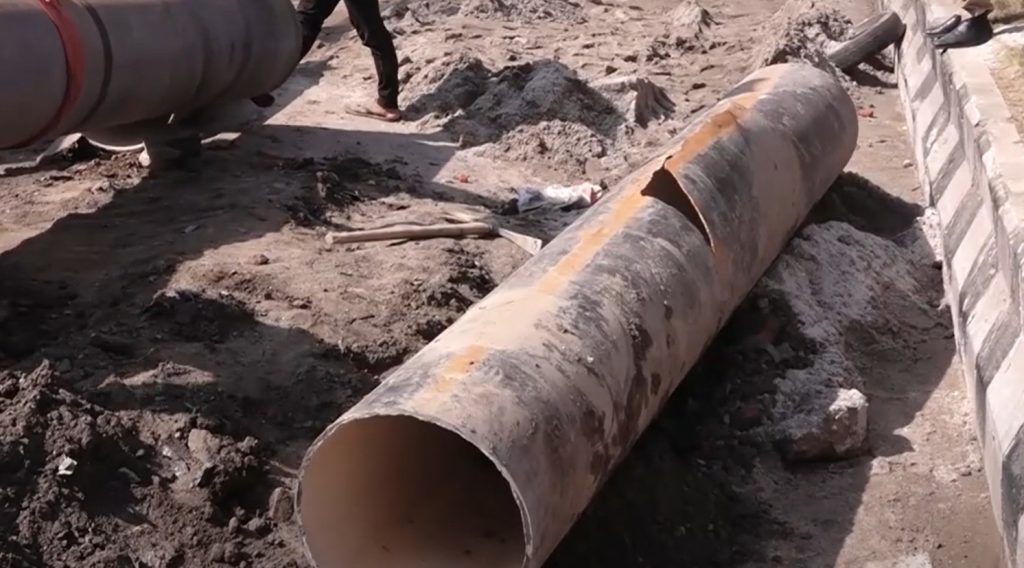
A recent break in the Melamchi water pipeline in Babarmahal, Kathmandu, caused chaos in the main artery of the capital. Roads and surrounding government and court buildings were buried by the expelled water, forcing staff and people to escape. As a result, crucial documents were destroyed, and court proceedings were halted. Similar devastation was caused months before by a similar pipeline burst in Naya Bazaar. The capital city frequently experiences mains ruptures. Water delivery measures have failed as a result of a troubling lack of coordination and carelessness among government authorities, including the Department of Roads, the Nepal Electricity Authority, and water supply organizations like KUKL and Melamchi Water Delivery Project.
The NEA’s carelessness in excavating roads for cable installations is to blame for the most recent supply pipe explosion. While digging for electrical lines in Babarmahal, the NEA contractor damaged a 20-inch Melamchi pipe by ignoring the GIS map that may have shown the pipeline’s position. Similarly, constructing roads during the rainy season usually results in careless excavation, muddy roads, and disrupted water supplies. Various agencies blame one another while the public suffers.
The Melamchi project is unquestionably an important strategy for addressing the water scarcity in Kathmandu. It started out with the goal of supplying the city with 200 million liters of water per day from the Melamchi River more than 20 years ago. For the people of Kathmandu, who cannot stand recurrent damage to the important project, the project is still essential despite exorbitant expenditures and years of delays. In place of the city’s previous reliance on ponds, rivulets, tankers, and tube wells, Melamchi supplies Kathmandu with a steady supply of water. However, because to regular pipeline failures, a sizable portion of this water never reaches households. To address this issue, agencies must work together. Proper pipe design and placement, informed by GIS maps, must come before road excavation.
The Melamchi project is unquestionably an important strategy for addressing the water scarcity in Kathmandu. It started out with the goal of supplying the city with 200 million liters of water per day from the Melamchi River more than 20 years ago. For the people of Kathmandu, who cannot stand recurrent damage to the important project, the project is still essential despite exorbitant expenditures and years of delays. In place of the city’s previous reliance on ponds, rivulets, tankers, and tube wells, Melamchi supplies Kathmandu with a steady supply of water. However, because to regular pipeline failures, a sizable portion of this water never reaches households. To address this issue, agencies must work together. Proper pipe design and placement, informed by GIS maps, must come before road excavation.
This is intolerable to the people of Kathmandu. If the authorities carry out their duties honestly, access to clean water can be achieved. People can have a plentiful supply of water if government agencies work closely together and projects are closely monitored. To solve a variety of lingering issues, the three agencies’ personnel must work together to enhance coordination. Instead of blaming one another for each scenario, it’s time for them to address important concerns. Better coordination, thorough planning, and high-quality craftsmanship are necessary to prevent pipeline bursts or electrical faults brought on by excavations.
Projects like Melamchi, which are financed by a combination of public funds and foreign aid, should not be affected by a lack of man-made disasters because they provide Kathmanduites with clean, safe drinking water, which is one of their fundamental rights.
Related posts:
 The Kathmandu Valley is building six substations to increase the electricity
 469 Nepali Workers Stranded in Saudi Arabia for Nine Months Still Await Rescue After Company Shut Down
 USD 1.5 billion worth of processed buffalo meat will be shipped to China each year
 Nepal’s revenue from the export of IT services increased by 20.28 percent in the first four months of the current fiscal year
 The NRB increases provisions to protect banks from the surge in bad debts
 Mayor Shah of KMC will take action against the Chief Executive Officer
 Nepal’s export revenue has increased by 16.5% due to an increase in edible oil exports
 The price of cardamom has risen to Rs 110,000 per mann, the highest in 12 years
 Beginning on January 23, GBIA will employ a satellite-based alternate landing system
 Current fiscal year saw a multiplication of bank loans secured by shares
 Operators of jet boats lament the absence of infrastructure
 The government’s budget cap for the next fiscal year is Rs 1.9 trillion