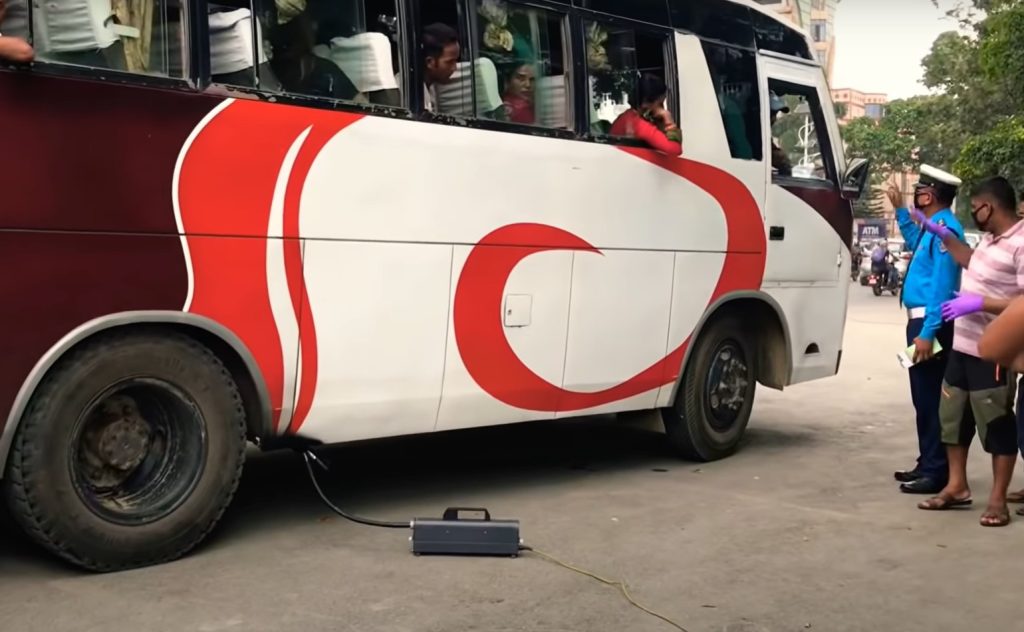
Beginning next week, the Kathmandu Metropolitan City plans to begin randomly testing automobiles on the road for emissions.
The city office’s relocation coincides with the Kathmandu Valley’s declining air quality.
“Two mechanical engineers have received the required training and will be deployed for emission testing,” stated Jagatman Shrestha, the city’s traffic expert adviser. “We have also collaborated with the federal government’s department of transport management, traffic police, and environment department to start these testing.”
To do emission testing, the city office has acquired two smoke meters, a portable instrument for evaluating vehicle emissions: one for gasoline-powered vehicles and one for diesel-powered vehicles. Motorcycles and scooters will also be examined for the first time, according to officials.
According to officials, the constitution requires local governments to take action to minimize pollution, even if federal government agencies are primarily in charge of automobile emission testing.
In compliance with the KMC Environment and Natural Resources Protection Act-2021, the city has created pollution control rules.
According to officials, all four-wheelers on the road normally have green stickers after passing emission testing from the department of transport management, and these arbitrary tests will be carried out on such vehicles. For a variety of causes, such as improper maintenance and servicing, some may still spew black smoke.
A lot of car owners just give their cars maintenance before the yearly pollution test.
“We will check emission levels instead of giving green stickers to cars,” Shrestha stated. “We will impose a fine on any vehicles that emit more pollutants than are allowed.”
Officials say that automobiles that pollute for the first time will be fined Rs 1,000.
One of the steps the municipal office is doing to combat air pollution is random car testing.
Additionally, the city’s air quality is now being independently monitored by the municipal environment department. The city office has set up portable gadgets in different places for that purpose.
The department’s chief, Sarita Rai, stated, “We are getting ready to install three more portable air quality monitoring devices in addition to the sixteen that we have already placed throughout the city.” “We’ve also started a campaign to raise awareness about air pollution.”
Nepal’s capital city frequently ranks as the most polluted city in the world, and the country’s air quality frequently approaches dangerous levels throughout the year.
IQ AirVisual, a Swiss organization that gathers air quality data globally, reports that on Friday afternoon, the PM2.5 levels in Kathmandu hit 197 micrograms per cubic meter (μg/m3).
Particulate matter (solid or liquid droplets) in the air with a diameter of less than 2.5 micrometers is referred to as PM2.5. It is one of the most harmful pollutants that can enter the bloodstream through the lungs after passing through the throat and nose. Due to their tiny size and propensity to remain floating in the atmosphere for extended periods of time, PM2.5 particles are more likely to be inhaled by humans.
According to the Environmental Protection Agency’s air quality index, air quality is deemed harmful when it hits 151-200; everyone may be affected, but sensitive groups may be more severely affected.
Due to the effects of dust and poisonous air, major hospitals report an increase in respiratory issues.
In the meantime, the city office said that, for the convenience of pedestrians, push-button traffic signals had been erected in 36 sites.
According to Shrestha, the city’s traffic adviser, “We’re trying to have those devices up and running soon.” “By activating the button to halt traffic, pedestrians can cross the street securely.”
At traffic crossroads, push-button devices are positioned to enable pedestrians to signal for traffic to halt so they can cross the street fearlessly.
Related posts:
 Mayor Shah of KMC will take action against the Chief Executive Officer
 KMC distributes vehicles in violation of its own policies
 Nirmala Sharma was chosen as the FNJ president
 Guidelines to implement the “Make in Nepal” program have been approved by the government
 Nepal confirms a second monkeypox case
 After an 88-day closure, Upper Tamakoshi is now generating electricity again
 The government completes an investment plan worth USD 46.5 billion to generate 28,500 MW of electricity by 2035
 Starting on January 14, a national ID card is required in order to open a bank account
 Residents object to the “careless” plan to discharge industrial wastewater into rivers
National ID card is required to access government services
Residents object to the “careless” plan to discharge industrial wastewater into rivers
National ID card is required to access government services
 The Siddhababa Tunnel’s construction is anticipated to improve traffic safety in Palpa
 Undocumented immigrants will be sent to Guantanamo by Trump