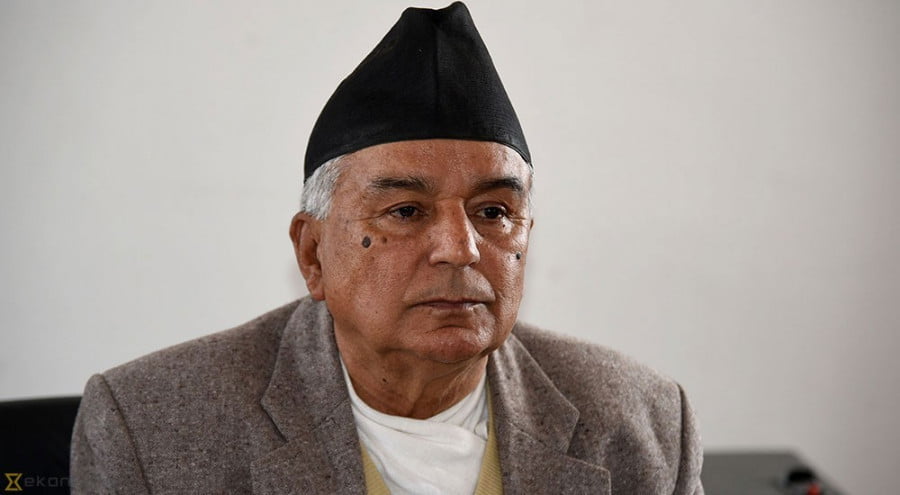
On the proposal of the Cabinet, President Ramchandra Paudel issued four ordinances on Monday; however, the proposed ordinance to change the National Park Act of 1973, the Forest Act of 2019, and the Land Act of 1964 was blocked.
“The President halted the ordinance for further study because it is sensitive and of public interest regarding the land, forests, and national parks,” Kiran Pokharel, President Paudel’s communications adviser, told the Post. “After reviewing the current legal framework and Supreme Court precedent, a decision regarding the ordinance will be made later.”
The regulation aims to grant landless Dalits and squatters who have constructed homes and resided on public land for an extended period of time free ownership. Squatters may also be granted land ownership under the ordinance by paying certain fees.
The Land and Forest Act policies need to be loosened because they are intertwined, according to Devi Gyawali, the former chair of the National Land Commission.
“The Land Act allows land that has been unused for more than ten years and has no agricultural use to be given to landless people,” Gyawali stated. Nonetheless, riverbanks are even recognized as forest areas under the Forest Act. For a long time, this has made it challenging to distribute land among the landless.
In 2019, the KP Sharma Oli government appointed Gyawali, a leader of the CPN-UML, as the chair of the Land Commission. Gyawali also asserts that the goal of the government-recommended land and forest laws was to resolve any ambiguity in the policy.
According to a source, the ordinance allots public and government properties to landless individuals who possess a registration certificate. “Based on the Land Commission’s suggestions, the administration had suggested the ordinance to the President in order to speed up the process.”
According to the source, who spoke on condition of anonymity, the administration also suggested amending the Forest Act because the land that would be allocated in this manner also falls inside the forest region.
According to a source close to the president’s office, “it is understandable that the President is not in a rush to endorse it because the ordinance also addressed the issue of the distribution of government land, which is highly politicized in matters related to squatters.”
According to the same source, the rule also permits businesses and real estate brokers to hang onto land past the present legal limit and to sell whatever land they were unable to sell in the past.
The insider went on to say that because land-related matters are delicate, Parliament should handle them instead of the ordinance.
An Ordinance to Amend Certain Nepal Acts Related to Promoting Good Governance and Public Service Delivery (2025), the Economic Procedure and Financial Accountability (First Amendment) Ordinance (2025), the Privatization (First Amendment) Ordinance (2025), and the Ordinance to Amend Certain Nepal Acts Related to Improving the Economic and Business Environment and Enhancing Investments (2025) are among the laws that the president has approved.
The government suggested that the President issue the ordinances on Friday, despite the opposition parties’ demands for the start of the House’s winter session to examine a number of topics, including the approval of the measures necessary to improve the efficiency of service delivery.
Related posts:
 Prabhu Bank guarantees Rabi’s release with a sum of Rs 22.5 million
 To increase sales, cash-strapped DDC looks to private companies and the Chinese market
 Police send an attorney a charge sheet about the cooperatives scam against RSP chairman Lamichhane and fifty other people
 KMC distributes vehicles in violation of its own policies
 Nepal is expected to experience a power outage because India is prepared to provide only 75 MW of electricity throughout the winter
 UML finally takes up constitution rewriting after defeating Congress
 The balloon festival in Pokhara is drawing more local tourists than foreign ones
 India and Nepal will discuss trade and commerce on Thursday
 Two hackers who increased Bhatbhateni’s tax liability by Rs 68 million are arrested by CIB
 Rabi Lamichhane gets released by the Chitwan District Court on a bail of Rs 5.4 million
 CAAN’s request to prohibit the import of European helicopters is rejected by the Aviation Ministry
 469 Nepali Workers Stranded in Saudi Arabia for Nine Months Still Await Rescue After Company Shut Down