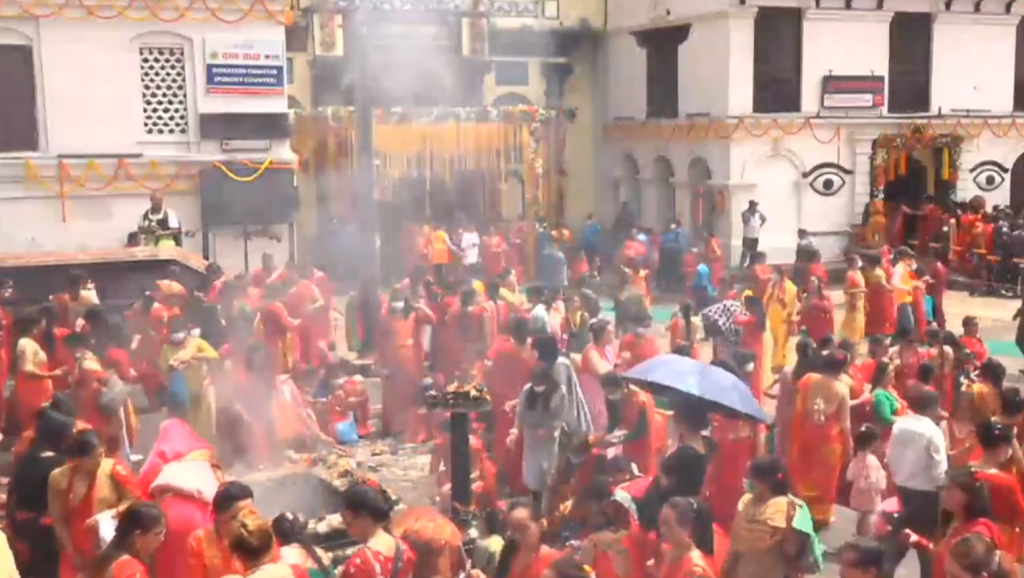
Women across Nepal are celebrating Haritalika Teej today by observing fasting, worshipping Lord Shiva and Goddess Parvati, and performing traditional rituals.
According to Hindu belief, fasting and offering prayers on this day bring family happiness, peace, and prosperity. The festival commemorates the legend of Goddess Parvati, who performed penance on this very day in the Satya Yuga at Gaurighat to attain Lord Shiva as her husband.
Mythological Origin of Haritalika Teej
As per ancient scriptures, when Parvati’s father, Himalaya, tried to marry her off to Lord Vishnu against her will, her friends abducted her and hid her in a secluded place. There, Parvati observed a strict fast and meditated, leading to her union with Lord Shiva. Since this event occurred on Bhadra Shukla Tritiya, the tradition of Haritalika Teej fasting began.
The word “Haritalika” comes from Sanskrit: Harit means “abducted,” and Alika means “female friends.”
Types of Teej Fasting and Religious Guidelines
Religious scholar Prof. Ram Chandra Gautam explained that fasting on Teej is not compulsory for all women to be foodless (nirahar). There are three forms of fasting: nirahar (without food and water), jalahar (with water), and phalahar (with fruits).
“One should choose the type of fasting according to health and capacity,” he said. “The scriptures emphasize self-care—‘protect yourself from all sides and then observe fasting.’”
He further clarified that fasting can also be done by consuming simple foods like wheat or corn bread, apples, oranges, or bananas, especially for those with health conditions.
Contrary to popular belief, Teej fasting is not only for the long life of husbands. It is also observed by unmarried girls and boys seeking a good partner, couples wishing for children, and women praying for family well-being.
Dar Feast: Pre-Fasting Tradition
A day before Teej, women enjoy a special feast called “Dar”, which includes various delicacies. Traditionally, this feast is organized by maternal families and brothers for daughters and sisters. According to scriptures, the Dar should be eaten by midnight of the previous day (Bhadra Shukla Dwitiya).
Cultural and Social Significance
Teej is not just a religious festival; it is also a platform for women to express their joys, sorrows, and struggles through songs and gatherings. However, in recent years, the festival has seen increasing commercialization and extravagance, with lavish jewelry displays, expensive dresses, and extended celebrations starting a month in advance.
Cultural experts warn that such practices distort the essence of the festival and create emotional pressure on those who cannot afford such luxuries. They emphasize preserving the original spirit of Teej.
Duration of Teej Festival
The formal Teej festival begins after the Dar feast and continues until Rishi Panchami.
- Bhadra Shukla Tritiya (Today): Haritalika Teej fasting and Shiva-Parvati worship.
- Bhadra Shukla Chaturthi: Ganesh Puja.
- Bhadra Shukla Panchami: Ritual bath and worship of Saptarishi and Arundhati, marking the conclusion of Teej.
Related posts:
 Teej Festival: Tradition, Belief, and Social Significance
 A law to regulate social media networks has been approved by the government
 Police send an attorney a charge sheet about the cooperatives scam against RSP chairman Lamichhane and fifty other people
 Nepal is expected to experience a power outage because India is prepared to provide only 75 MW of electricity throughout the winter
 The NAC Wide-Body Aircraft Corruption Scam will be investigated again
 339,000 people receive NOC over a four-year period
 The NRB suggests new regulations that would let cooperatives to get bank loans
 Two hackers who increased Bhatbhateni’s tax liability by Rs 68 million are arrested by CIB
 Today we observe Martyrs’ Day
 Rabi Lamichhane gets released by the Chitwan District Court on a bail of Rs 5.4 million
 While TIA taxiway expansion is halfway complete, other construction projects are not as advanced
 CAAN’s request to prohibit the import of European helicopters is rejected by the Aviation Ministry